
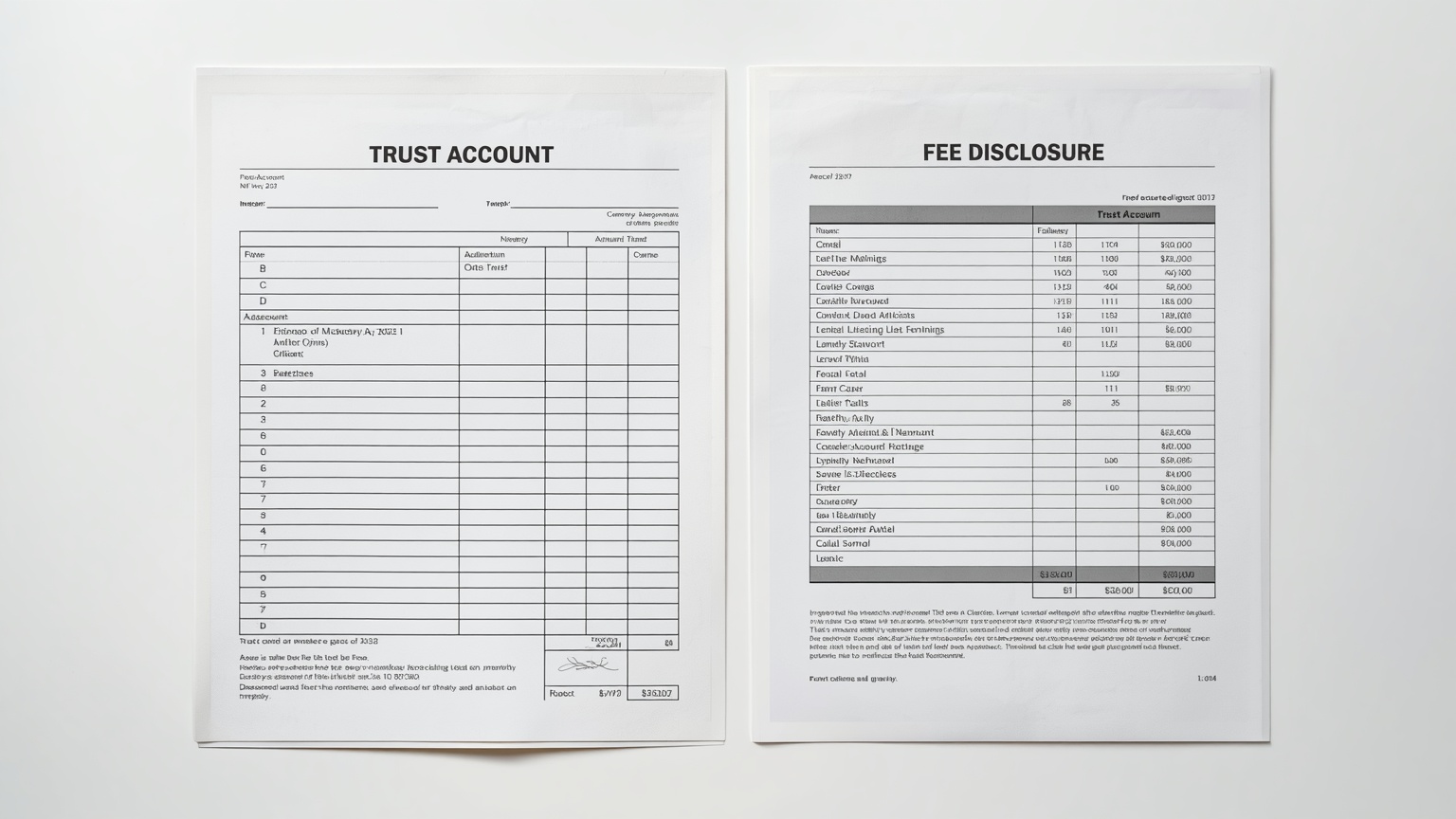

The California Department of Real Estate examines broker fee handling and trust account operations more frequently — and more closely — than almost any other compliance topic. The rules are not abstract; they are operational. A broker who handles fees correctly never thinks about them again. A broker who handles fees incorrectly discovers, mid-audit, that a single misallocated $500 retainer 18 months ago has triggered a citation, a trust account review, and a request for the past three years of records.
This guide is a focused operating checklist for the parts of DRE compliance that touch borrower money — what goes into the trust account, what doesn’t, when an advance fee agreement is required, when advance fees cannot be collected at all, and where brokers most commonly slip. It is not a substitute for legal advice on specific transactions, and Geraci LLP works with brokers individually on the harder cases.
The First Question on Every Fee: Did the Broker Advance It?
The threshold question for any fee or expense received from a borrower is whether the broker already advanced it. The answer drives where the fee goes:
- The broker advanced the cost (paid the appraiser, paid the credit report vendor, paid for a third-party report from broker funds) → the borrower’s reimbursement does not go into the trust account. It is reimbursement, not custodial money. It goes directly to the broker’s general account.
- The borrower paid the fee in advance, before the underlying service was provided → the funds belong in the trust account until the service is completed.
This is the rule that catches the most brokers in audit. A broker who instinctively deposits every borrower payment into the trust account ends up with a trust account that contains funds that don’t belong there, which itself is a violation. A broker who treats every payment as general-account income ends up with custodial funds in the operating account, which is a worse violation.
Appraisal and Credit Report Fees: Four Operating Rules
Appraisal and credit report fees deserve their own treatment because they are the most frequently mis-handled item on the file. Four rules:
1. No reimbursement detour through the trust account. If the broker has already paid the vendor, the borrower’s repayment goes to the broker’s general account. Do not route reimbursements through trust. 2. No undisclosed markup. The fee charged to the borrower must equal the fee actually charged by the appraiser or credit-report vendor. Any markup must be separately disclosed to the borrower as a loan cost. A markup baked into the fee without disclosure is a violation. 3. Clear accounting records. Every advance and reimbursement must be traceable in the broker’s accounting records. A fee that cannot be tied to a specific vendor invoice and a specific borrower transaction is a fee the broker cannot defend in audit. 4. Written borrower instructions for movements between accounts. When funds need to move from the trust account to the broker’s general account — even for legitimate fee earnings — the borrower’s written authorization should be in the file.
The DRE has additional, stricter rules around fees that are negotiable with the borrower (where the fee charged is not pinned to a vendor invoice). When in doubt, treat the fee as trust-eligible until the lender has confirmed otherwise with counsel.
When an Advance Fee Agreement Is Required
For fees that are not appraisal or credit report fees — origination fees, processing fees, loan modification fees, forbearance fees, and similar — the broker is collecting an “advance fee” if the fee is collected before the underlying services are completed. Advance fees are governed by a specific compliance framework:
- An advance fee agreement is required. The agreement must spell out what services the fee covers, what the fee amount is, and how it will be handled.
- The advance fee agreement must be submitted to the DRE. The DRE pre-approves the agreement for the specific transaction. Templates are not pre-approved for repeated reuse — each transaction’s agreement requires its own DRE submission and approval.
- Funds must be held in the trust account. Even with a valid advance fee agreement, the collected funds belong in the trust account until the broker has completed the services contracted for. They cannot be moved to the broker’s general account before the services are performed.
The simplest defensible posture for many brokerages is to avoid collecting advance fees altogether, structuring the engagement so fees are collected at closing or at completion of the contracted service. When that is not feasible, the advance fee agreement and DRE approval process must be followed for each transaction.
When Advance Fees Are Prohibited Entirely
There are categories of work for which advance fees cannot be collected even with an advance fee agreement and DRE approval:
- Loan modifications. Advance fees for modification services are restricted by both DRE rules and overlapping state-law protections. Brokers handling modifications generally cannot collect their fee until the modification has actually been completed.
- Forbearance agreements. Advance fees for negotiating forbearance arrangements are similarly restricted. The fee must be earned before it is collected.
The rationale is borrower protection. In modification and forbearance contexts, the borrower is by definition under financial stress, and the regulatory concern is that advance-fee collection in that posture creates incentives for brokers to take fees and fail to deliver. The rule is strict: do not collect advance fees on these matters.
A broker who is asked to handle modifications or forbearances and is unsure whether a particular fee structure is compliant should review the RE 7 manual and consult with counsel before accepting funds. The cost of a compliance review is trivial compared to the cost of an enforcement action triggered by a prohibited fee collection.
Trust Account Operating Discipline
The trust account itself has to be operated to a standard the DRE will recognize as compliant in audit. The minimum discipline:
- Separate trust account at a federally insured institution. Borrower funds, investor funds, and similar custodial money cannot be commingled with broker operating funds.
- Reconciliation on a documented schedule. Monthly reconciliations of the trust account against the broker’s records of beneficial ownership are standard. Some thresholds and certain broker categories trigger more frequent reconciliation.
- Documented disbursement authorizations. Any disbursement from the trust account requires documented authority — an executed agreement, written borrower instruction, or completion of contracted services.
- No trust account overdrafts, ever. A trust account overdraft is itself a serious DRE issue. The broker cannot “borrow” from the trust account to cover other obligations, even temporarily.
- Records retained for at least four years. Trust-related records, including investor and self-dealing documentation, fall into the four-year retention category, longer than the standard three-year DRE retention period.
A defensible trust account program is built on a small number of clear written procedures, applied consistently, and audited internally before the DRE audits externally.
Where Brokers Get Cited Most Often
Across DRE audits, the recurring trust-account and advance-fee citations are predictable:
- Reimbursements for broker-advanced costs improperly routed through the trust account
- Markups on appraisal and credit report fees not disclosed as loan costs
- Advance fees collected without an advance fee agreement
- Advance fees collected with a template agreement that was never submitted to the DRE for the specific transaction
- Advance fees for loan modifications or forbearances collected before services were completed
- Trust account funds moved to general accounts without documented borrower authorization
- Reconciliation gaps that show in the audit but were never noticed by internal controls
- Records retention failures, especially on investor-related documents that fall under the four-year rule
Each one of these is solvable with a written procedure, a periodic internal review, and a willingness to push back on borrower or referral-partner requests that don’t fit the rules.
The Three Questions Every Broker Should Be Able to Answer in Audit
A useful self-check: a compliant brokerage’s owner or compliance officer should be able to answer the following three questions in writing, on the spot, without consulting the file:
1. Where does each category of fee go? Appraisal, credit report, origination, processing, modification, forbearance — each one has a defensible answer about whether it lives in the trust account, in the general account, or is prohibited entirely. 2. What is the procedure for moving funds out of the trust account? Who authorizes, what documentation is required, when in the transaction lifecycle the movement occurs, how the movement is recorded. 3. What does an advance fee agreement look like for this brokerage, and how does it get to the DRE? A specific written process, not “we’d ask our attorney.”
If any of these answers requires looking something up, the brokerage’s compliance posture is weaker than it should be.
Where Geraci LLP Helps
Geraci LLP works with California real estate brokers and private money brokers on the operational side of DRE compliance — trust account procedures, advance fee agreements and DRE submission, fee-handling protocols, audit response, and remediation when a citation has already been issued. The firm also reviews and updates compliance manuals to align with the current DRE expectations and the brokerage’s actual operations.
If your brokerage is preparing for a DRE audit, restructuring its fee-collection practices, or responding to a citation, contact Geraci LLP.



