
Updated: January 2025
By Geraci LLP Banking & Finance Team
Introduction: Navigating Borrower Defaults
Loan defaults occur across all economic cycles and borrower types. Whether triggered by job loss, business downturns, property damage, or poor financial management, defaults require lenders to make strategic decisions balancing asset recovery, cost management, and borrower relationship preservation.
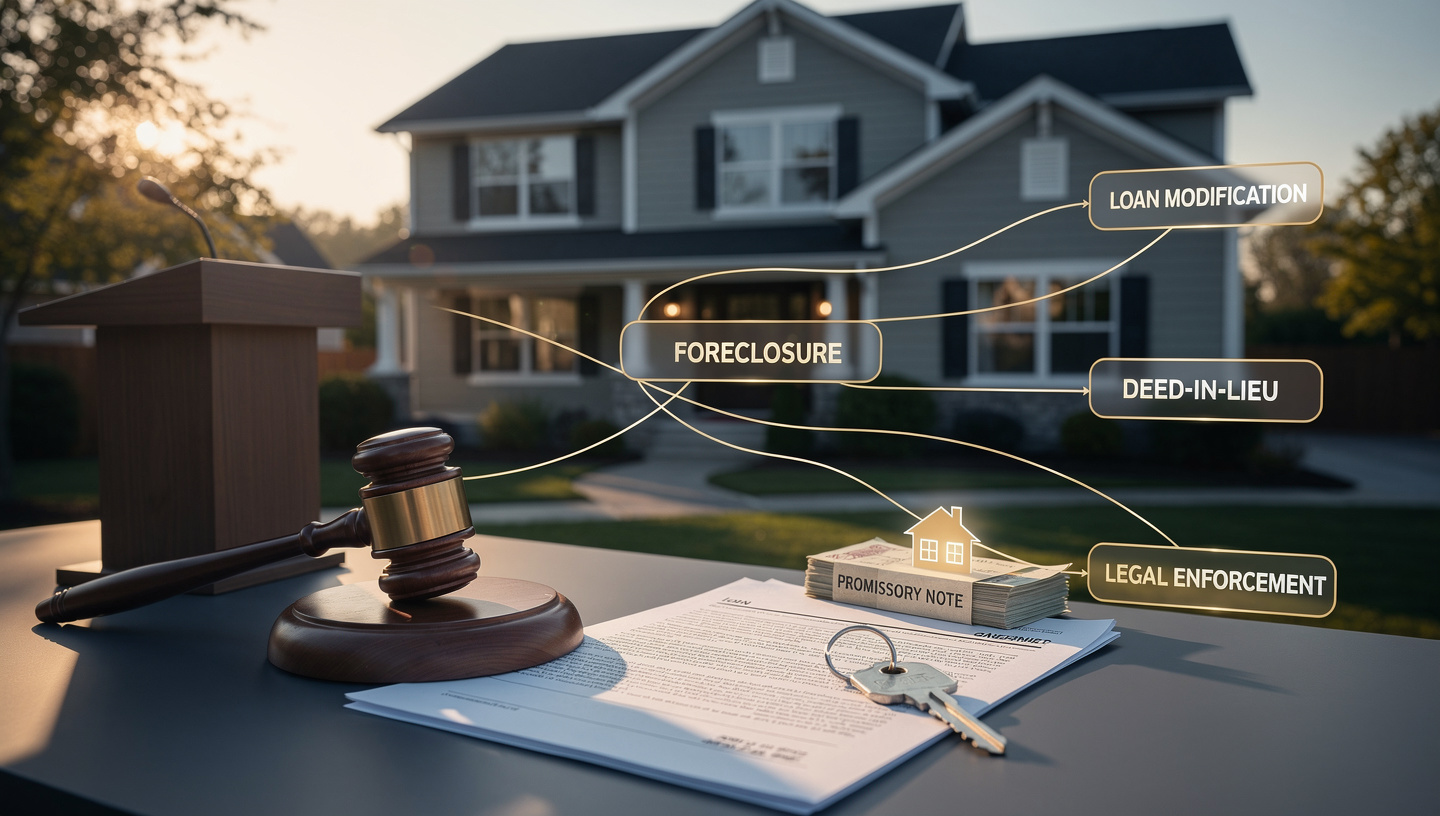
Private lenders facing borrower defaults have five primary remedies available, ranging from informal workout negotiations to aggressive litigation. Selecting the appropriate remedy depends on borrower cooperation, collateral value, deficiency exposure, and recovery timeline priorities.
This guide examines each default remedy option, analyzes strategic considerations, and provides implementation guidance for private lenders.
Remedy Option 1: Notice of Default / Demand Letter
Purpose and Function
A Notice of Default (NOD) or demand letter serves as the formal notification to borrowers that loan terms have been violated and lender intends to pursue remedies unless the default is cured.
Strategic Functions
1. Legal Prerequisite
Many loan documents require written notice before lender can accelerate debt or initiate foreclosure. NOD satisfies this contractual requirement and creates evidence of compliance.
2. Cure Opportunity
Provides borrower with specific information needed to cure:
- Exact default amount
- Breakdown of delinquent payments, fees, and costs
- Cure deadline (typically 10-30 days depending on loan documents and state law)
- Payment instructions
3. Communication Tool
Encourages borrower to contact lender to discuss workout alternatives. Many defaults can be resolved through informal arrangements once borrower understands the seriousness of the situation.
4. Documentation for Foreclosure
Creates paper trail demonstrating lender’s compliance with notice requirements, essential if foreclosure or litigation becomes necessary.
Best Practices
Timing: Send NOD after borrower misses first payment but before relationship deteriorates. Early communication often prevents escalation.
Remedy Option 2: Forbearance Agreements
Structure and Purpose
Forbearance agreements provide temporary payment relief while borrower recovers from short-term financial hardship. Lender agrees not to accelerate the loan or initiate foreclosure for a defined period in exchange for borrower meeting specific conditions.
When Forbearance Makes Sense
Appropriate Scenarios:
- Temporary income disruption (job loss with new employment secured, seasonal business downturn)
- Property value exceeds debt (limited foreclosure benefit)
- Borrower has demonstrated reliability prior to default
- Default triggered by specific event with clear resolution timeline
Critical Forbearance Provisions
1. Acknowledgment of Debt
Borrower confirms:
- Outstanding balance amount
- No defenses or offsets to debt
- Validity of original loan documents
2. Waiver of Claims
Borrower waives any claims against lender arising from the loan relationship.
3. Default Consequences
Clearly state that forbearance default results in immediate acceleration and foreclosure without additional notice.
4. Preservation of Rights
Lender’s agreement to forbear does not waive any other rights or remedies.
Remedy Option 3: Loan Modifications
Structure and Purpose
Loan modifications permanently alter loan terms to make ongoing payments affordable for borrower while preserving lender’s long-term recovery.
Modification vs. Forbearance
| Feature | Forbearance | Modification |
|---|---|---|
| Duration | Temporary (3-12 months) | Permanent |
| Loan Terms | Unchanged | Altered |
| Deferred Amounts | Must be repaid | Often capitalized into principal |
| Documentation | Simple agreement | Requires deed of trust modification |
When Modifications Make Sense
Appropriate Scenarios:
- Permanent income reduction but borrower can afford lower payment
- Property value declined; foreclosure would result in loss
- Borrower has substantial equity making them unlikely to walk away
- Long-term loan preservation more valuable than short-term recovery
Critical Modification Provisions
1. Modification of Deed of Trust – If term extended or principal modified, deed of trust must be amended and re-recorded.
2. Reaffirmation of Guaranties – Guarantors must acknowledge modification and reaffirm guaranty (otherwise may be released).
3. Borrower Financial Documentation – Obtain updated financials proving modification justified.
4. No Waiver Language – Modification does not waive lender’s rights regarding future defaults.
Remedy Option 4: Foreclosure (Judicial vs. Non-Judicial)
Non-Judicial Foreclosure
Advantages:
- Speed: 4-6 months typical timeline
- Cost: $3,000-$8,000 total
- Certainty: Standardized statutory process
Judicial Foreclosure
Advantages:
- Deficiency Judgment Available: Can pursue borrower for shortfall
- Court Supervision: Provides additional procedural protections
- Title Issues Resolved: Court determines lien priorities
Remedy Option 5: Receiver Appointment
Purpose and Function
A receiver is a court-appointed third party who takes possession and control of the property during litigation or foreclosure. The receiver:
- Collects rents from tenants
- Pays property expenses (taxes, insurance, maintenance)
- Prevents borrower from accessing property income
- Preserves property value pending resolution
When Receivers Are Appropriate
Ideal Scenarios:
- Income-producing property (apartments, commercial, retail)
- Borrower diverting rents rather than paying debt
- Property deteriorating due to borrower neglect
- Long foreclosure timeline expected (receiver preserves value during delay)
Receiver Appointment Process
Requires Judicial Proceeding: Cannot appoint receiver through non-judicial foreclosure. Lender must:
- File lawsuit (judicial foreclosure or separate action)
- Request receiver appointment in complaint or by motion
- Demonstrate need (rents being diverted, property waste, etc.)
- Post bond (typically required by court)
- Court appoints receiver and grants authority
Costs and Timing
Typical Costs:
- Receiver’s fees: $2,000-$10,000+ per month (depends on property size/complexity)
- Attorney fees for motion: $3,000-$8,000
- Court-required bond: Varies
- Net effect: Receiver should generate positive cash flow; fees paid from property income
Remedy Option 6: Litigation Beyond Foreclosure
Additional Lawsuit Scenarios
1. Breach of Contract / Guaranty Enforcement
Sue borrower and/or guarantors for:
- Outstanding debt
- Attorney’s fees and costs
- Damages from breach
2. Fraudulent Conveyance Claims
If borrower transferred property or assets to avoid creditors, lender can sue to set aside fraudulent transfers and recover assets for debt satisfaction.
3. Fraud Claims
If borrower made material misrepresentations in loan application or during loan term, lender can sue for damages (may support punitive damages, unlike contract claims).
4. Turnover Orders
Force borrower to turn over assets, rents, or funds to satisfy judgment.
Strategic Litigation Considerations
Dual-Track Foreclosure and Lawsuit: Some lenders pursue foreclosure (to recover collateral) and simultaneously file lawsuit (for deficiency, fraud claims, receiver appointment).
Selecting the Appropriate Remedy: Decision Matrix
| Scenario | Recommended Remedy | Rationale |
|---|---|---|
| Borrower cooperative, temporary hardship | Forbearance or Modification | Preserves relationship, minimizes costs |
| Borrower uncooperative, property value ≈ debt | Non-Judicial Foreclosure | Fast, cost-effective recovery |
| Substantial deficiency, collectible borrower | Judicial Foreclosure + Lawsuit | Maximizes recovery potential |
| Income property, rents being diverted | Judicial Foreclosure + Receiver | Preserves cash flow, prevents waste |
| Fraud or misrepresentation suspected | Litigation (fraud claims) | Punitive damages, broader remedies |
| Multiple junior liens, priority disputes | Judicial Foreclosure | Court determines priorities |
Best Practices Across All Remedies
1. Communicate Early and Often
- Contact borrower immediately upon default
- Document all communications
- Explore workout before pursuing foreclosure
2. Coordinate with Servicer
If loan is being serviced, ensure servicer is informed of workout negotiations, forbearance or modification terms, foreclosure instructions, and payment arrangements.
3. Document Everything
- Maintain detailed file of all borrower communications
- Preserve evidence of property condition
- Document decision-making process
4. Consult Legal Counsel
- Review loan documents to confirm available remedies
- Ensure compliance with state-specific foreclosure requirements
- Assess litigation risks and costs before proceeding
5. Consider Tax and Accounting Implications
- Debt forgiveness may trigger taxable income to borrower
- Loan modifications may require asset write-downs
- REO property acquisition creates tax reporting obligations
Conclusion
Loan defaults require strategic decision-making balancing recovery speed, cost, borrower cooperation, and long-term relationship value. The five primary remedies—notice of default, forbearance, modification, foreclosure, and litigation—each serve distinct purposes depending on circumstances.
Successful default resolution requires:
- Early borrower communication
- Realistic assessment of recovery prospects
- Cost-benefit analysis of each remedy option
- Strict compliance with procedural requirements
- Coordination between lender, servicer, and legal counsel
About Geraci LLP
Geraci LLP’s litigation and banking teams provide comprehensive default resolution services for private lenders. Contact us for strategic guidance on remedy selection and implementation.
This article is for informational purposes only and does not constitute legal advice. Lenders should consult qualified legal counsel regarding specific default situations.
© 2025 Geraci LLP. All rights reserved.