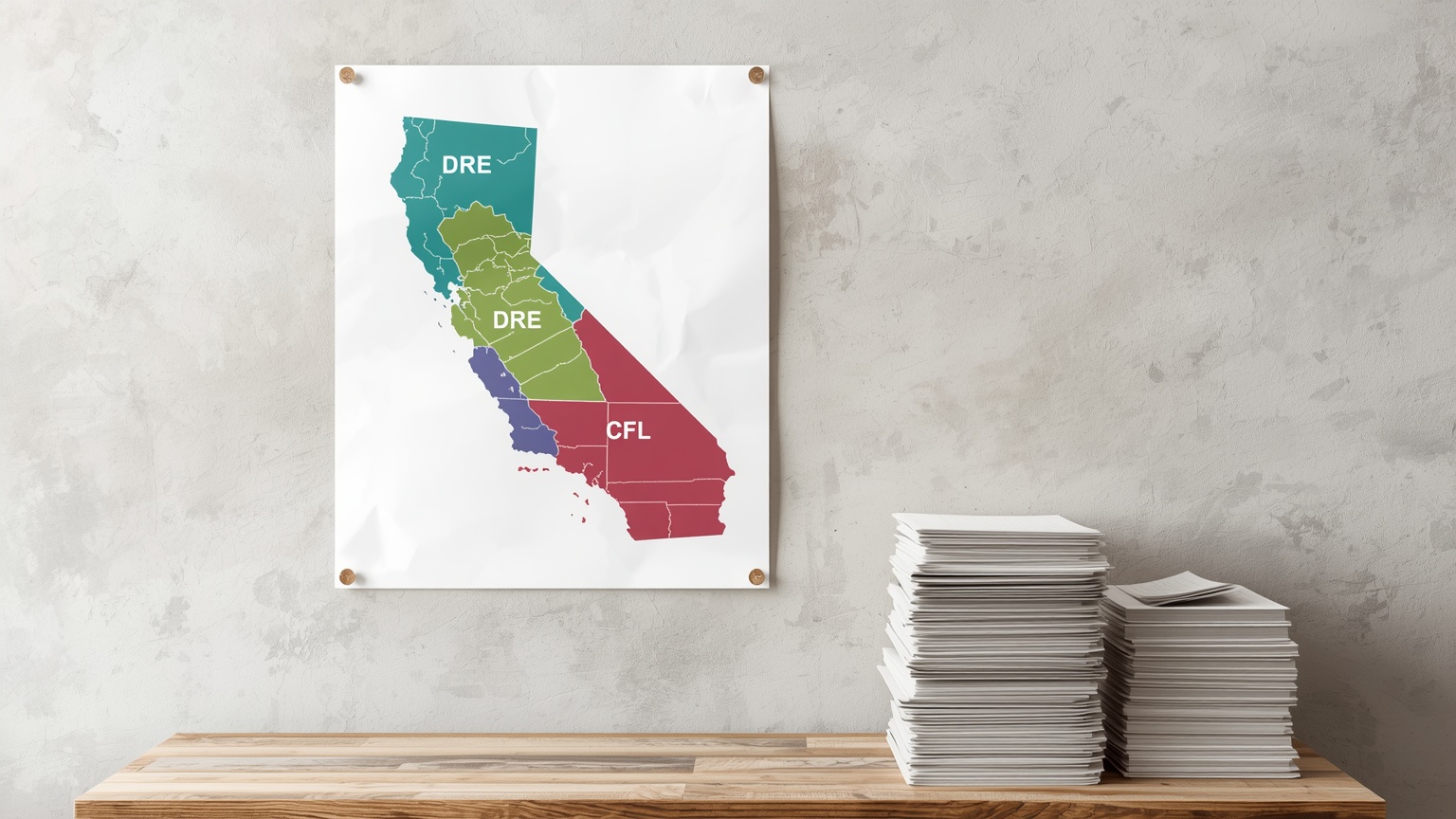

California’s mortgage licensing landscape confuses many private lenders entering the market. With two distinct regulatory agencies overseeing lending activities, understanding when each license applies—and how they interact—determines whether your operations remain compliant.
Two Agencies, Two Licensing Regimes
California private lending falls under dual regulatory oversight:
California Department of Real Estate (DRE): Issues real estate broker licenses that permit mortgage origination when acting as an intermediary.
Department of Financial Protection and Innovation (DFPI): Issues California Financing Law (CFL) licenses for entities that lend their own funds.
These licensing regimes aren’t mutually exclusive, which creates confusion. Many lenders qualify for both and must determine which best suits their business model.
Common Licensing Questions Answered
Do I Need a CFL License If I Have a DRE License?
No. A DRE broker license permits successful private lending operations. However, many lenders eventually obtain CFL licenses for specific advantages:
1. Balance Sheet Lending: CFL licenses better suit lenders funding from their own capital 2. Reduced Reporting: CFL reporting obligations differ from DRE requirements 3. Underwriting Flexibility: CFL lenders aren’t bound by certain DRE limitations
Can I Upgrade My CFL License for Consumer Loans?
No. The DFPI requires a completely separate application through the NMLS portal for consumer lending authority. Your existing business-purpose CFL license doesn’t convert or upgrade.
Can CFL Licensees Sell Loans to the Public?
This remains a problematic area. CFL licenses limit loan sales to “institutional investors” and other CFL licensees. The DFPI’s definition of “institutional investor” under the California Financing Law differs significantly from common industry usage.
While some case law suggests CFL licensees may sell to the public, both courts and the DFPI acknowledge this activity could trigger DRE licensing requirements. The DRE hasn’t publicly clarified its position. Given this uncertainty, selling loans to public investors as a CFL licensee without DRE broker involvement carries substantial regulatory risk.
Do I Need a License to Buy Loans in California?
Generally, no. Both the DRE and DFPI regulate loan origination, funding, and sale—not purchase. However, an important exception applies:
If you’re purchasing loans with held-back funds designated for future advances or draws, licensing becomes necessary. A CFL license suffices for this activity.
Maintaining Your CFL License
CFL license maintenance requires attention to three areas:
- Maintain minimum $25,000 net worth
- Keep surety bond current
- File annual report by March 15 each year
- Missing this deadline results in license revocation
- Address changes
- New officers, directors, managers, or general partners
- Ownership changes exceeding 10%
- New branch locations
Strategic Considerations
Can I Hold Both Licenses?
Yes—and many portfolio lenders should. Dual licensing provides:
- Maximum transactional flexibility
- Ability to structure deals under either regime
- Reduced compliance risk through license choice optimization
CFL License Geographic Scope
CFL licenses authorize California lending only. They provide no authority for loans on properties located outside California.
Out-of-State Applicants
Out-of-state entities can obtain CFL licenses with modified application procedures:
- Signature pages require notarization
- Background checks use FBI fingerprint cards instead of LiveScan
Physical Office Requirements
Neither the DRE nor DFPI requires a brick-and-mortar California office for license maintenance.
Multiple Entity Broker Designation
A DRE-licensed broker may serve as broker of record for multiple corporations, providing flexibility for lenders operating through various entities.
Choosing Your License Strategy
Your optimal licensing approach depends on business model:
- Loan brokerage operations
- Selling loan participations to multiple investors
- Acting as intermediary between borrowers and capital sources
- Balance sheet lending with proprietary capital
- Simplified regulatory reporting
- Maximum underwriting flexibility
- Portfolio lenders seeking transaction flexibility
- Operations requiring both brokerage and direct lending capabilities
- Risk mitigation through license selection optimization
Loan Servicing Considerations
CFL licensees may service their own loans without additional licensing. However, servicing loans for third parties requires separate authorization.
The DFPI imposes no trust accounting requirements for CFL licensees servicing their own portfolio loans, simplifying operational compliance.
Best Practices for License Selection
1. Analyze Transaction Types: Determine whether you’re primarily brokering or direct lending 2. Consider Capital Source: Balance sheet lending often favors CFL structure 3. Evaluate Reporting Burden: Compare DRE and DFPI reporting requirements 4. Plan for Growth: Consider whether future expansion favors one license over another 5. Consult Professionals: Licensing decisions affect securities compliance, tax treatment, and operational structure
Conclusion
California’s dual licensing system offers flexibility but requires careful navigation. Understanding which license—or combination of licenses—suits your business model prevents compliance gaps while maximizing operational efficiency.
For lenders uncertain about their licensing needs or considering license modifications, consulting with legal counsel experienced in California lending regulation ensures proper structure from the outset.