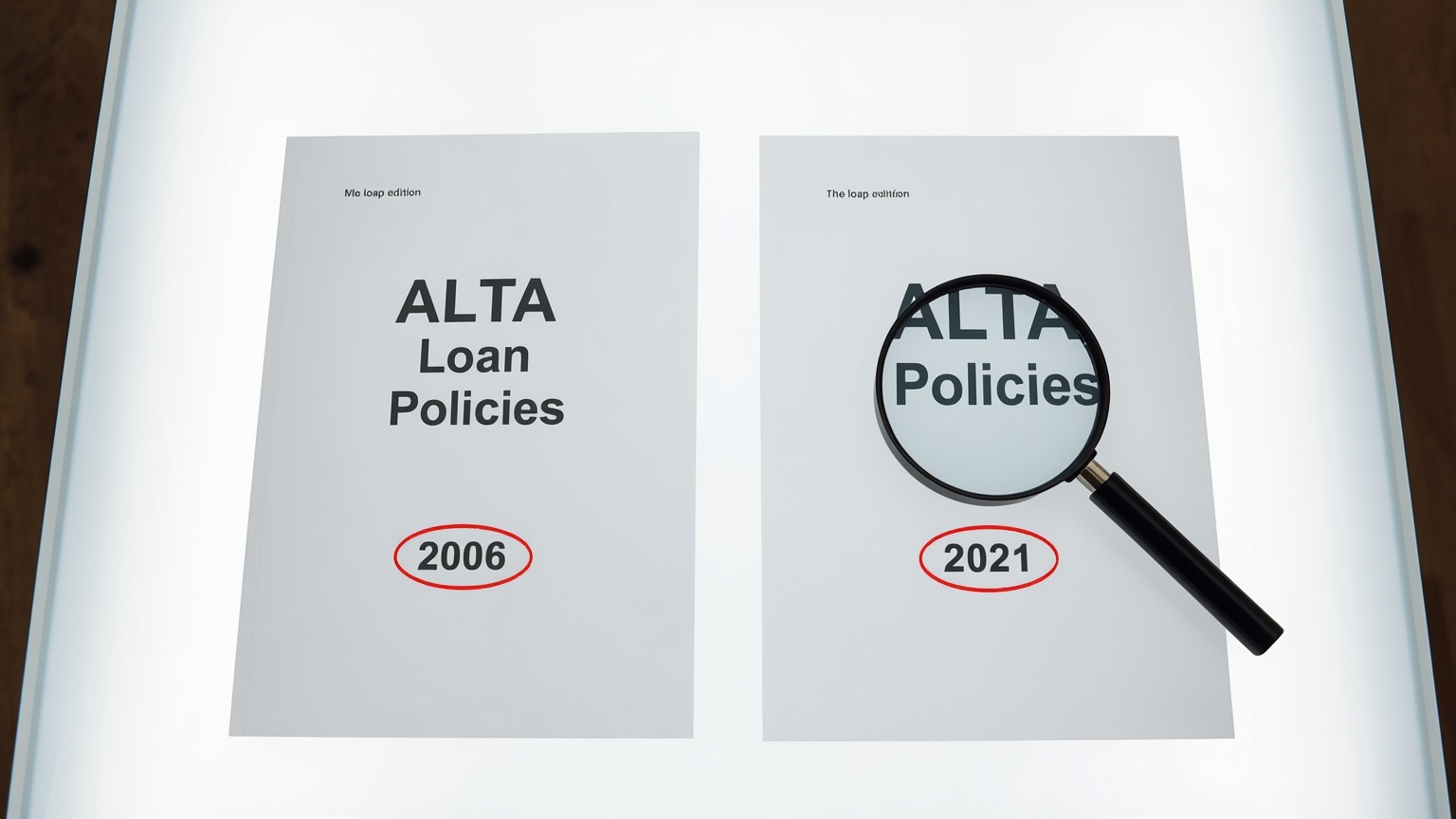

The American Land Title Association (ALTA) transitioned from the longstanding 2006 loan policy to the updated 2021 version, which is now the standard form issued by title companies across the country. For private lenders making business-purpose loans, understanding the distinctions between these two policy generations is essential for evaluating title insurance coverage and managing risk effectively.
While the majority of revisions involve grammatical refinements and language harmonization across ALTA’s suite of policies and endorsements, several substantive changes directly affect how lenders are protected. This analysis from Geraci LLP breaks down the most impactful modifications, what they mean for your lending operations, and how to adapt your strategies accordingly.
Electronic Signatures and Remote Online Notarization
The 2021 loan policy formally acknowledges electronic signatures and Remote Online Notarization (RON) as valid execution methods. Under Covered Risks #2(a)(iii), #2(a)(viii), #9(c), and #9(h), coverage now explicitly extends to loan documents that were executed using e-signatures or notarized through remote online platforms where state law permits.
Additionally, the preamble to the 2021 policy clarifies that policies and endorsements issued in entirely electronic format carry the same validity as their physical counterparts. This built-in language effectively eliminates the need for a separate ALTA 39 endorsement, since the policy itself now incorporates nearly identical protections.
Zoning, Permits, and Enforcement Notices
Covered Risk #5 retains similar zoning and regulatory protections but introduces important new terminology. The 2021 policy replaces generic references to recorded notices with the defined term “Enforcement Notice.” Coverage for violations of zoning ordinances, building permits, and similar regulatory matters now requires that such violations or enforcement actions be specifically described in an Enforcement Notice that appears in the Public Records.
The definition of “Public Records” has also been refined. It now explicitly excludes “alternate filing systems,” which encompass records related to environmental protection, planning, permitting, zoning, licensing, building codes, health regulations, public safety, and national security matters. Private lenders should be aware that this exclusion narrows the universe of records the title insurer is obligated to search.
Broader Protection Against Fraud and Forgery
Covered Risk #9 has been strengthened in an important way. The 2006 policy contained contradictory language stating that coverage “includes but is not limited to” a specific enumerated list of causes that could impair the security instrument. The 2021 revision removes the limiting phrase, making the list of causes expressly non-exhaustive. This means the policy now covers a wider range of circumstances that could render a security instrument invalid or unenforceable, particularly those involving fraud, forgery, lack of signing authority, or defective notarization.
This is a meaningful improvement for private lenders, as it broadens the safety net against title defects arising from borrower misconduct or procedural failures in the loan origination process.
Priority Coverage Under Covered Risk #10
One of the most consequential changes appears in Covered Risk #10, which governs priority of the insured lien. Under the 2021 policy, the default coverage scope has narrowed. Priority protection now extends only to:
- Loan principal actually disbursed as of the date of the policy
- Accrued interest as of the policy date
- Reasonable foreclosure expenses
- Protective advances made before obtaining title (covering insurance premiums, real estate taxes, and HOA assessments)
This represents a reduction from the 2006 policy’s broader default coverage of the full “Indebtedness” as defined in the loan documents. However, lenders can restore comprehensive priority coverage by obtaining an ALTA 14 endorsement, which adds protection for future principal disbursements and additional categories of indebtedness, including advances made to protect the secured property itself.
Private lenders with construction loans, revolving credit facilities, or any loan structure involving future advances should consider the ALTA 14 endorsement essential.
Expanded Bankruptcy Protections
Covered Risk #13, which addresses invalidity, unenforceability, or avoidance of the insured lien, has been expanded under the 2021 policy to include losses resulting from an “alternative remedy” ordered by a bankruptcy court.
In practical terms, this means the policy now covers scenarios where a bankruptcy trustee recovers the secured property or its value through a court order, or where the court directs the insured lender to return payments received from a borrower in bankruptcy proceedings. The amount of any such repayment obligation is now within the scope of policy coverage, providing lenders with an additional layer of protection in borrower insolvency situations.
PACA-PSA Trust: New Exclusion #7 and Limited Coverage
Among the most significant additions in the 2021 policy is new Exclusion #7, which removes coverage for claims arising from a PACA-PSA trust. These trusts are established under two federal statutes: the Perishable Agricultural Commodities Act (PACA) and the Packers and Stockyards Act (PSA).
How PACA-PSA Trusts Work
These federal laws protect growers and producers of perishable fruits, vegetables, and livestock from non-payment by buyers. When a buyer purchases these goods, federal law requires the buyer to hold the goods and any proceeds from their resale in trust for the benefit of the sellers. Courts have interpreted this trust obligation broadly, extending it to all assets acquired or maintained using trust proceeds, including real property.
Why This Matters for Lenders
If a borrower uses funds traceable to PACA-PSA trust proceeds to make mortgage payments, the secured real estate could become subject to the trust. The grower or producer would then hold a super-priority claim that takes precedence over the lender’s security interest.
While Exclusion #7 removes general PACA-PSA trust claims from coverage, new Covered Risk #8 provides limited protection. Coverage is available if and to the extent that enforcement of the trust is described in a recorded Enforcement Notice.
Lenders making loans to borrowers in the food industry, including restaurants, food distributors, grocery operations, and agricultural businesses, should pay particular attention to this exclusion and consider additional due diligence regarding potential PACA-PSA trust exposure.
New Exclusion #9: Discrepancies in Property Area
Exclusion #9 codifies what has long been industry practice but was frequently misunderstood. This exclusion makes explicit that the policy does not cover discrepancies in the quantity of land area, square footage, or acreage.
For years, some practitioners and claimants mistakenly believed that Covered Risk #2(c), which addresses matters that would be disclosed by a survey, provided coverage for inaccuracies in property dimensions through its use of the word “variation.” Exclusion #9 eliminates this ambiguity by clearly stating that such dimensional discrepancies fall outside the policy’s coverage.
Expanded Definition of “Insured”
The 2021 policy broadens the definition of who qualifies as an “Insured” to include affiliates of the original named insured under specific circumstances. An affiliate becomes an insured party when it:
- Acquires title from the original named insured by deed, or
- Obtains title through foreclosure or a deed-in-lieu of foreclosure
The policy also introduces a formal definition of “Affiliate” in the definitions section: an Entity that (i) is wholly owned by the Insured, (ii) wholly owns the Insured, or (iii) is wholly owned by the same person or Entity that wholly owns the Insured.
This expansion is particularly beneficial for private lenders that operate through multiple affiliated entities or transfer properties between related companies during workout or disposition scenarios.
Higher Coverage Limits After Failed Defense
Under the 2006 policy, Condition 8(b)(i) provided that if the title insurer undertook a defense of the insured’s title and that defense was unsuccessful, coverage limits would automatically increase by 10%. The 2021 policy, now under Condition 8(c)(i), raises this automatic increase to 15%.
This enhanced provision gives lenders greater financial protection in situations where the title insurer’s defense efforts prove unsuccessful.
Fair Market Value Calculation Options
The 2021 revisions introduce important flexibility in how fair market value is determined when calculating covered losses under Condition 8. The insured now has two options for establishing fair market value:
1. Foreclosure date method: Based on the date the insured acquires title through foreclosure or deed-in-lieu 2. Extinguishment date method: Based on the date the security instrument is extinguished or rendered unenforceable
When the title insurer has elected to defend the title and that defense fails, the insured lender gets to choose which valuation method applies. In volatile or rapidly appreciating real estate markets, this choice can result in significantly different loss calculations, making it a powerful tool for maximizing recovery.
ALTA 30 Endorsement: Consumer Protection Exclusion
The revised ALTA 30 endorsement now includes an additional internal exclusion for losses arising from any “Consumer Protection Law.” This aligns the ALTA 30 with its companion endorsement, ALTA 30.1, which already contained a similar (though slightly differently worded) exclusion. While this represents a modest narrowing of coverage, it brings consistency across the endorsement family.
New ALTA 34.1 Endorsement
The 2021 revisions introduce a new ALTA 34.1 endorsement alongside the existing ALTA 34. The key differences between these two endorsements are:
- ALTA 34: Requires a final court order enforcing the identified risk before coverage is triggered
- ALTA 34.1: Covers losses arising from the exercise or enforcement of the identified risk by an adverse party, without requiring a court order
The ALTA 34.1 includes an open-ended format for describing the “Identified Risk,” providing flexibility in tailoring coverage. However, the trade-off is that the ALTA 34.1 does not obligate the title insurer to pay costs, attorneys’ fees, or expenses incurred in defending the title.
Strategic Takeaways for Private Lenders
The transition from ALTA 2006 to ALTA 2021 brings a mix of expanded protections and targeted coverage reductions. For private lenders operating in the business-purpose loan space, the most actionable items include:
- Request the ALTA 14 endorsement on every loan to restore full priority coverage for future advances
- Conduct PACA-PSA due diligence when lending to food industry borrowers
- Leverage the fair market value election in workout and loss scenarios
- Understand the 15% automatic coverage increase when the insurer defends title unsuccessfully
- Review affiliate structures to take advantage of expanded insured definitions
The attorneys at Geraci LLP work with private lenders nationwide on title insurance strategy, loan documentation, and regulatory compliance. If you have questions about how the ALTA 2021 policy affects your lending program, our team is ready to help.