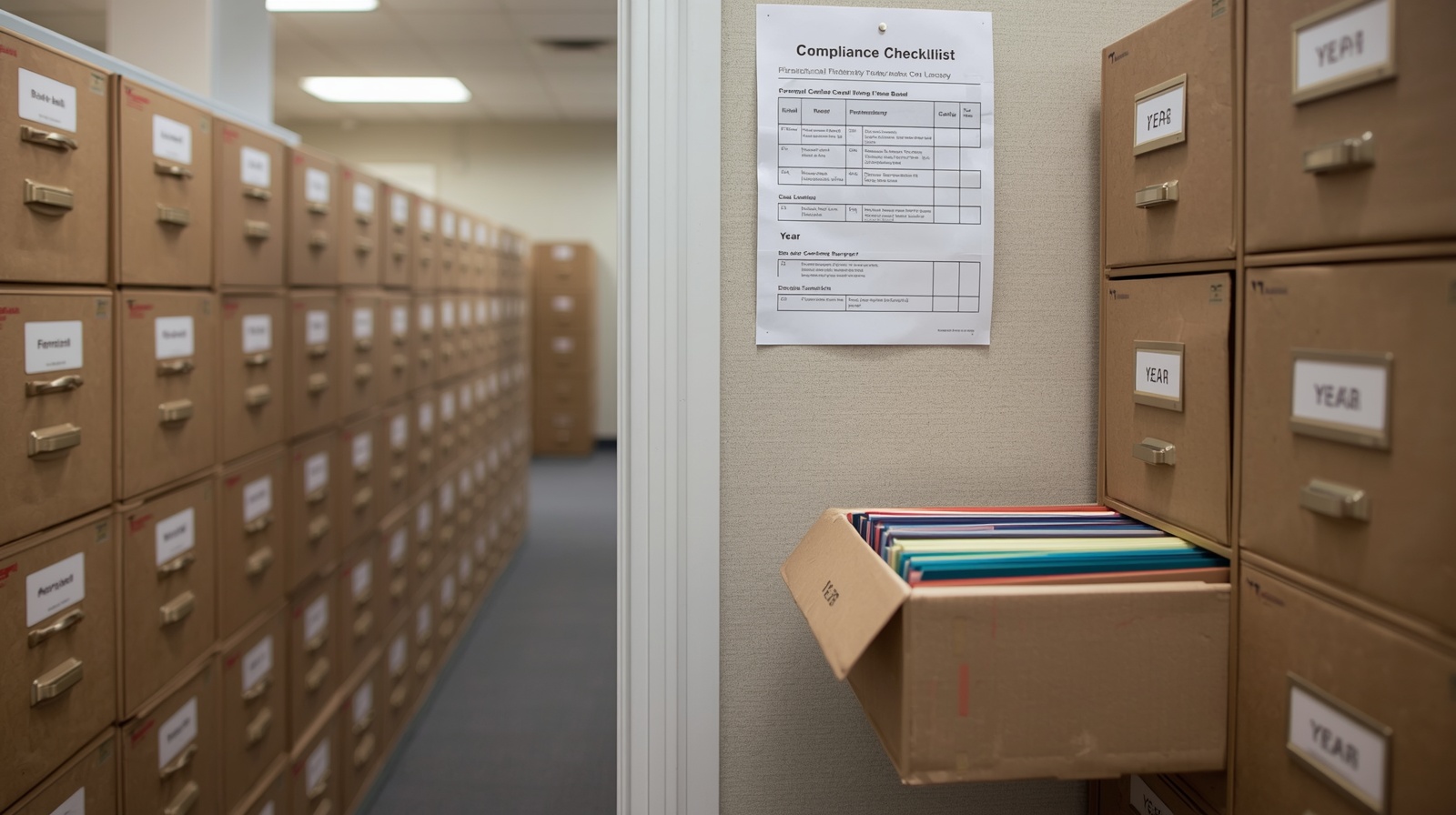

Proper recordkeeping is one of the most overlooked yet critically important compliance obligations facing California real estate professionals. While the day-to-day demands of closing transactions and managing client relationships naturally take priority, failing to maintain adequate records can expose brokers, agents, and private lenders to disciplinary action, license revocation, and significant legal liability. This guide breaks down the statutory requirements, practical considerations, and best practices that every California real estate professional should implement to protect their business and their license.
California’s Statutory Recordkeeping Framework
The Three-Year Minimum Under Business and Professions Code Section 10148
California Business and Professions Code Section 10148 establishes the foundational recordkeeping obligation for licensed real estate brokers. Under this statute, brokers must retain copies of all listings, deposit receipts, canceled checks, trust account records, and any other documents they execute or obtain in connection with real estate transactions for a minimum of three years from the date of closing or, if the transaction does not close, from the date of the listing.
This three-year requirement represents the statutory floor, not the ceiling. As discussed below, there are compelling legal and practical reasons to retain records well beyond this minimum period.
Digital Records and Electronic Communications
In today’s digital-first business environment, a significant portion of transaction-related communications occur through email, cloud-based platforms, and electronic document management systems. California law treats electronic records with the same weight as their paper counterparts, meaning that emails exchanged during the course of a real estate transaction fall squarely within the retention mandate of Section 10148.
However, not all electronic communications carry the same retention obligation. A statutory clarification that took effect on January 1, 2015, specifically excludes text messages, instant messages, and social media posts (such as tweets) from the Section 10148 retention requirement. The sole exception applies when these communications are deliberately created for the purpose of establishing a permanent record of the transaction. In practice, this means that a text message confirming a meeting time would not need to be retained, but a text message memorializing agreed-upon contract terms could potentially fall within the retention mandate.
Real estate professionals should exercise caution with this exclusion. Even though text messages may not be subject to the three-year statutory retention period, they can still be discoverable in litigation and may serve as critical evidence in disputes. A prudent approach is to transfer any substantive transactional communications from text or messaging platforms into a more permanent record format, such as email or a document management system.
Consequences of Non-Compliance
The California Department of Real Estate (DRE) takes recordkeeping violations seriously. Depending on the severity and circumstances of the infraction, the DRE may impose penalties ranging from formal reprimand to license suspension or outright revocation. Beyond regulatory consequences, inadequate recordkeeping can severely undermine a professional’s ability to defend against civil claims, as the absence of documentation often creates adverse inferences in litigation.
Why Three Years Is Not Enough
Statutes of Limitation for Real Estate Claims
While Section 10148 mandates a three-year retention period, California’s statutes of limitation for real estate-related claims create exposure windows that extend well beyond this timeframe. Buyers have between three and four years from the date they discover a defect or breach to initiate legal action against sellers, depending on the underlying cause of action. Breach of written contract claims carry a four-year statute of limitations, while fraud claims allow three years from the date of discovery.
Critically, the discovery rule means that the limitations clock does not begin running until the injured party knew or reasonably should have known about the defect or breach. In practice, this means a buyer who purchases a property in 2025 might not discover a material defect until 2030, and could then have until 2033 or 2034 to file suit. By that point, the three-year statutory retention period would have long expired.
Agent Liability Extends Beyond the Transaction
California courts have broadened the scope of legal actions that can be brought against real estate agents, not just sellers. An agent’s duty of disclosure, duty of competence, and fiduciary obligations can give rise to claims years after escrow closes. Communications regarding representation agreements, property disclosures, inspection findings, and negotiation positions may become essential evidence in defending against these claims.
This extended liability exposure means that records destroyed after the three-year minimum period could leave agents without the documentation they need to mount an effective defense. The cost of maintaining digital records is negligible compared to the potential liability of being unable to produce them.
Building an Effective Records Retention Program
Digitization as the Foundation
The most cost-effective and reliable approach to long-term recordkeeping is comprehensive digitization. Scanning all paper documents into a secure digital format accomplishes several objectives simultaneously:
- Eliminates physical storage costs associated with maintaining filing cabinets and offsite document warehouses
- Protects against loss from fire, flood, theft, or other physical hazards
- Enables rapid retrieval when documents are needed for regulatory audits, litigation discovery, or client inquiries
- Facilitates organized categorization through folder structures, metadata tagging, and full-text search capabilities
When digitizing records, ensure that scans are of sufficient quality to be legible and that the digital files are stored in widely accessible formats such as PDF. Original documents with wet signatures should be retained for a reasonable period after scanning to ensure the digital copies are complete and accurate.
Cloud Storage and Backup Protocols
Modern cloud storage platforms offer real estate professionals affordable, scalable, and secure solutions for long-term document retention. When selecting a cloud storage provider, consider the following factors:
- Encryption standards: Both at-rest and in-transit encryption should be enabled
- Access controls: Role-based permissions ensure that only authorized personnel can view or modify sensitive documents
- Audit trails: The ability to track who accessed, modified, or downloaded files provides accountability and supports compliance documentation
- Redundancy: Multiple backup locations protect against data loss from any single point of failure
- Retention policies: Automated retention and deletion rules can help ensure compliance with regulatory requirements
Organizing Records by Transaction
Each transaction file should contain a comprehensive set of documents, including but not limited to:
- Listing agreements and amendments
- Purchase agreements and counteroffers
- All addenda and disclosures
- Inspection reports and related communications
- Escrow instructions and closing statements
- Trust account records and deposit receipts
- All email correspondence related to the transaction
- Agent notes and file memoranda
- Marketing materials and MLS listings
Recommended Retention Periods
While the statutory minimum is three years, Geraci LLP recommends the following retention schedule for California real estate professionals:
- Transaction documents: Minimum seven years, preferably permanent digital retention
- Trust account records: Minimum seven years (consistent with IRS audit exposure)
- Correspondence and communications: Minimum seven years
- Listing agreements (expired/canceled): Minimum five years
- Corporate and entity records: Permanent retention
These extended periods provide a meaningful buffer against late-discovered claims and align with IRS record retention guidelines for business records.
Special Considerations for Private Lenders
Private lenders operating in California face additional recordkeeping obligations beyond those applicable to traditional real estate brokers. Loan origination files, servicing records, borrower communications, and compliance documentation must be retained in accordance with both state lending regulations and applicable federal requirements.
The California Financing Law (CFL) and the California Real Estate Law impose distinct recordkeeping requirements depending on the lender’s licensing structure. Private lenders should work with experienced legal counsel to develop retention policies that address the full spectrum of their regulatory obligations.
Additionally, private lenders who participate in the secondary market must maintain records sufficient to demonstrate compliance with representations and warranties made in connection with loan sales or securitizations. These records may need to be retained for the life of the loan plus additional buffer periods specified in the applicable purchase or participation agreements.
Take Action to Protect Your Business
Implementing a robust records retention program is not merely a regulatory checkbox. It is a fundamental risk management strategy that protects your license, your reputation, and your financial interests. The cost of maintaining organized digital records is minimal compared to the potential consequences of being unable to produce critical documentation when it matters most.
Geraci LLP advises real estate professionals, private lenders, and mortgage fund operators throughout California on compliance, licensing, and risk management. If you have questions about your recordkeeping obligations or need assistance developing a retention policy tailored to your business, contact our team at (949) 403-3488 or visit us at 90 Discovery, Irvine, CA 92618.