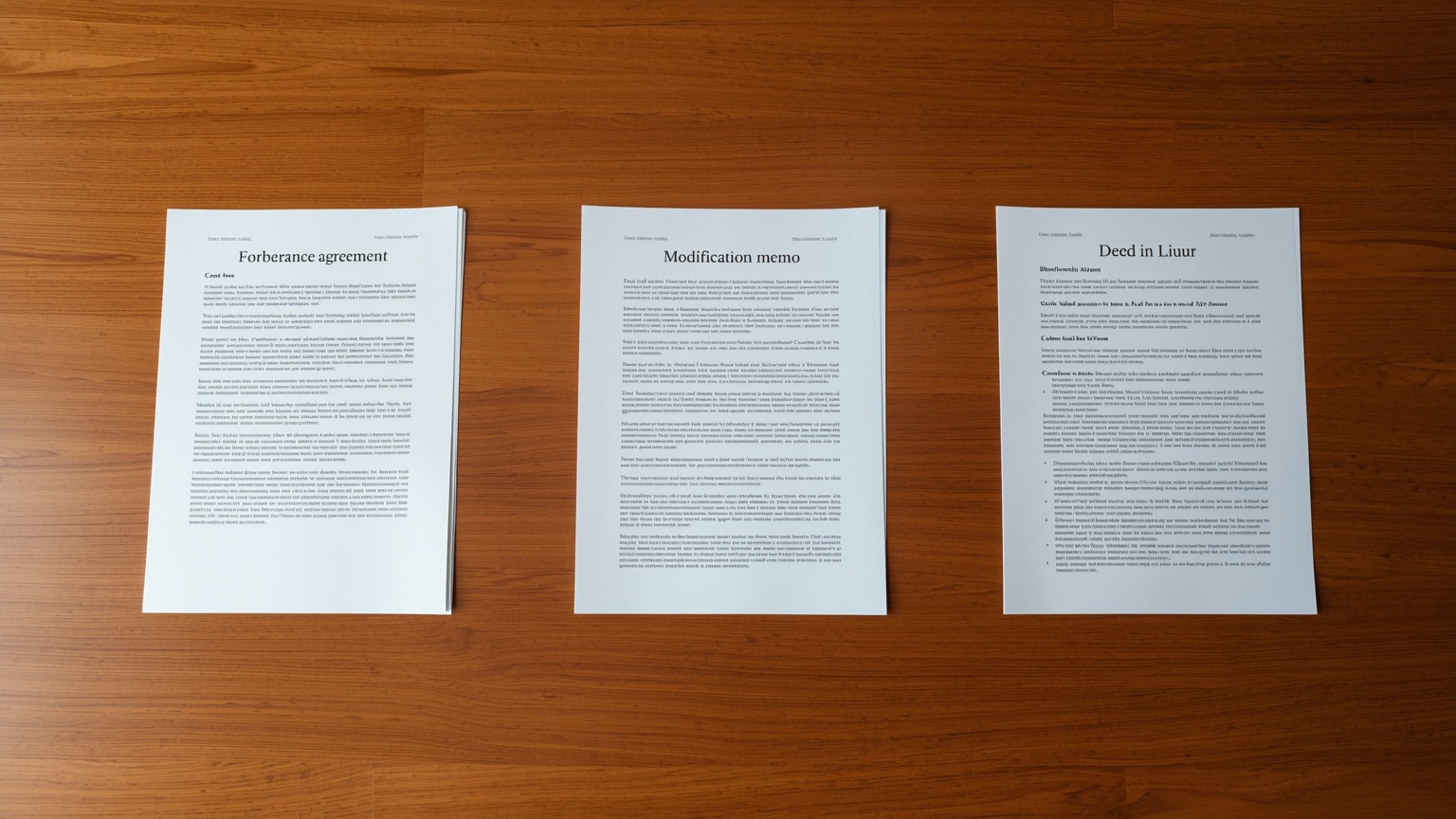

Every private lender eventually faces a loan that doesn’t perform as expected. Whether the issue is a missed payment, an expired maturity date, a lapsed insurance policy, or something more serious, defaults happen — and how a lender responds in the early stages can significantly affect both the financial outcome and the legal exposure down the road. This guide covers the primary workout strategies available to private lenders when a borrower cannot meet their obligations, along with the documentation requirements and practical considerations that govern each approach.
Establishing the Right Communication Practices from the Start
Before examining the specific workout tools, it’s worth emphasizing that the foundations of a successful workout are laid long before any formal agreements are signed. When a borrower goes into default, the way a lender communicates and documents every interaction matters.
Verbal conversations should always be followed by written confirmation — typically an email sent immediately after a call that summarizes the lender’s understanding of what was discussed. This creates a contemporaneous record that can neutralize later borrower claims that promises were made or terms were agreed to informally. The Great Recession produced a significant volume of lender liability litigation based on alleged oral representations from lenders to distressed borrowers, and those disputes continue to arise today.
All formal communications should be sent to the notice address specified in the loan documents, with certified mail preferred. At the outset of every loan, lenders should verify that the borrower’s notice address is accurate and usable, because a bad notice address creates problems in every subsequent default scenario.
Equally important: any agreement that changes the terms of a loan or formally alters the lender-borrower relationship must be signed by both parties. This is distinct from the original loan closing, where only the borrower signs because the lender’s funding constitutes their acceptance. In a workout, the lender is typically offering something — additional time, a rate adjustment, a pause on enforcement — and that mutual consideration requires mutual signature.
The Three Primary Workout Tools
Forbearance Agreements
A forbearance is, at its core, the lender agreeing not to exercise certain rights for a defined period of time. In the typical default scenario, the lender forbears from beginning — or continuing — foreclosure. The default itself remains in place throughout the forbearance period. The lender is not curing the default; they are simply agreeing to pause enforcement while the borrower has an opportunity to catch up, sell, refinance, or otherwise resolve the situation.
Forbearance agreements are highly customizable documents. The lender may require monthly payments during the forbearance period, or they may agree to a full payment deferral. There may be an upfront forbearance fee. The agreement might also address accumulated default interest, late charges, or other amounts that the lender is willing to waive or defer as part of the arrangement.
Documentation for Forbearances
The forbearance must clearly define what the lender is forbearing from. The scope matters because forbearance agreements can be entered at any point in the enforcement process:
- Before any notice of default has been recorded (in California, this is the beginning of the non-judicial foreclosure process)
- After a notice of default has been recorded, in which case the agreement must address whether the NOD will be rescinded or left in place
- Even after a notice of trustee’s sale has been recorded, with the lender coordinating with the foreclosure trustee to postpone the sale date
In California, a lender who has already recorded a notice of default has two options: rescind it (which requires restarting the entire foreclosure timeline if the forbearance expires without repayment) or leave it in place (which preserves the existing timeline but requires the trustee to postpone the sale). Each approach carries different strategic implications depending on the borrower’s situation and the lender’s timeline.
Loan Modifications
A modification differs from a forbearance in one fundamental respect: it cures the existing default. When a modification goes into effect, the loan is in good standing — the default is resolved, not merely paused. This makes the modification a more permanent resolution, appropriate when both parties are prepared to restructure the loan on new terms and move forward.
Common modification terms include:
- Extension of the maturity date
- Increase in the interest rate (a common trade-off for granting additional time)
- Principal reduction in exchange for a partial payoff
- Recapitalization of accrued default interest or fees into the loan balance
Because the modification represents a restructuring of the underlying loan, every term that is being changed must be explicitly addressed in the document. Standard modification forms should include language confirming that all terms not expressly modified remain unchanged and fully in effect.
If the lender has been in forbearance discussions with the borrower, a modification may naturally follow if the borrower demonstrates the ability to sustain a restructured loan going forward. The forbearance buys time; the modification provides a new baseline.
When to Record a Modification
Lenders sometimes choose not to record a modification, particularly for straightforward maturity extensions. A modification is legally enforceable whether or not it is recorded. However, recording a modification can enable a lender to obtain a date-down endorsement to the existing title policy — something that is not possible for unrecorded documents. Before deciding not to record, lenders should consider whether title policy currency matters in the current scenario and whether recording provides meaningful protection.
Deeds in Lieu of Foreclosure
A deed in lieu is the most complex and final of the three primary workout options. The borrower executes a deed conveying the property directly to the lender, effectively transferring ownership without going through the formal foreclosure process. For borrowers who want to avoid having a foreclosure on their record, and for lenders who want a faster path to property ownership than formal foreclosure provides, a deed in lieu can be attractive — but it requires careful preparation.
A deed in lieu can only be validly executed when the loan is already in default and the lender has the right to foreclose. A deed in lieu obtained at origination, at the time of a loan extension, or during any period when the loan is in good standing is not enforceable. Courts view such arrangements as an improper circumvention of the foreclosure statutes that states have specifically enacted to protect borrowers. If a lender attempts to use a deed in lieu to bypass foreclosure protections from the outset, the borrower can successfully challenge it in court on public policy grounds.
The one nuanced exception involves the combination of a forbearance and a deed in lieu. Under a forbearance, the default remains active — the loan is technically still in default even though the lender has agreed to pause enforcement. Some lenders and borrowers agree simultaneously to a forbearance and a deed in lieu, with the deed in lieu held unrecorded during the forbearance period. If the borrower does not cure the default during the forbearance period, the lender records the deed. This arrangement is permissible precisely because the default persists throughout the forbearance.
Title Due Diligence Is Non-Negotiable
Before proceeding with a deed in lieu, the lender must obtain an updated title search — a full preliminary title commitment, not a property profile or informal search. The reason is fundamental: unlike a foreclosure sale, a deed in lieu does not wipe out junior liens. The lender takes the property subject to everything on title at the time of transfer. A deed in lieu that brings with it unexpected mechanic’s liens, judgment liens, junior deeds of trust, or other encumbrances may create a situation where the property cannot be sold without first resolving those issues.
After reviewing the title report, the lender may conclude that foreclosure is actually the better option — specifically because foreclosure eliminates junior liens while a deed in lieu does not.
Title Insurance Is Vital
Title companies are generally cautious about deeds in lieu and may require additional underwriting before issuing an owner’s title policy. Nevertheless, obtaining a new owner’s policy on the transferred property is essential. Without title insurance, the lender assumes the risk that the deed itself — or the chain of title leading to it — could later be challenged. A title insurer willing to issue an owner’s policy provides meaningful protection against that risk.
Negotiating Deed in Lieu Terms
Several issues must be resolved in every deed in lieu:
- Recourse after transfer. As a general rule, deed in lieu agreements release the borrower from further liability on the debt. However, recourse against guarantors is negotiable. Lenders often prefer to maintain the right to pursue guarantors for any deficiency; guarantors, naturally, prefer to be released. Whatever is agreed must be clearly documented.
- Proceeds sharing. To make the deed in lieu more attractive to a borrower who feels they are giving up equity, the lender can agree to share proceeds with the borrower after the property is sold. The structure typically provides that the lender is made whole first (principal, accrued interest, fees), with any remaining proceeds split with the former borrower. This provision must be drafted carefully to address timing and to prevent disputes about when the lender must make payment.
- Personal property. The deed transfers real property. Any fixtures, equipment, or personal property that will transfer along with the real estate must be specifically identified in a bill of sale. Failure to address personal property in the documentation creates a basis for post-transfer disputes.
- Borrower authority. Just as the lender verified the borrower’s authority to execute the original loan documents, the lender must verify authority to enter the deed in lieu agreement. If the borrower is an LLC, the appropriate member resolution or consent is required.
Key Documentation Provisions That Apply Across All Workouts
Regardless of which workout strategy is selected, several provisions should be standard in every workout agreement:
Loan History Recitals. The recitals section should tell the loan’s story from the lender’s perspective — when the loan was made, what default occurred, when it occurred, and how the lender has responded. A clear factual record in the recitals demonstrates that the lender acted in good faith and makes it significantly harder for a borrower to later claim that the workout was coercive or one-sided.
Reaffirmation of Loan Terms and Amounts Due. The agreement should identify all amounts currently owed, including principal, accrued interest, default interest, late charges, legal fees, foreclosure costs, and any other charges that have accrued. Borrowers sometimes attempt to dispute the amounts in subsequent litigation; a borrower’s signature on a document setting out the agreed amounts substantially limits that avenue of attack.
Business Purpose Reaffirmation. The agreement should include an express reaffirmation that the loan was made for business purposes. This matters because one of the most significant risks in any enforcement or workout is a borrower claiming the loan was a consumer loan — which would trigger a very different regulatory and legal framework. Every opportunity to obtain a signed business purpose reaffirmation should be taken.
Non-Owner Occupancy Reaffirmation. On business purpose loans secured by properties the borrower is not occupying as a primary residence, a reaffirmation of non-owner occupancy status protects against claims that regulatory protections applicable to owner-occupied properties apply.
Authority Verification. The lender must confirm that the individuals executing the workout agreement are duly authorized to do so on behalf of the borrower entity. Get the same authorization documentation (member resolutions, officer certificates, etc.) that was obtained at origination.
Release of Claims. A broad release of any claims the borrower might assert against the lender — subject to statutory limitations — is a standard and valuable component of workout agreements. While certain statutory claims (like some usury claims) cannot be prospectively waived, many potential causes of action can be released. A comprehensive release provides meaningful protection against future litigation.
Future Default Provisions. In addition to confirming the existing default, the workout agreement should define new events of default — including requirements specific to the workout scenario. For example, if the borrower is expected to list the property for sale within 30 days, failure to do so can be made an express default. These customized default triggers give the lender clear enforcement rights without needing to re-litigate whether a new default has occurred.
Conditions Precedent. If the workout agreement requires the borrower to satisfy conditions before it becomes effective — such as paying a forbearance fee, delivering insurance certificates, or providing updated financial information — those conditions must be clearly identified. An agreement signed by both parties but not yet satisfied as to its conditions precedent is not effective; if the conditions are not met, the lender can treat the workout as having never occurred.
Enforcement Tools Beyond the Three Core Strategies
When negotiated workouts fail, lenders have several additional enforcement mechanisms available:
Assignment of Rents. Most commercial deeds of trust include an assignment of rents provision, and lenders can activate this assignment by sending the statutory notice to tenants directing them to pay rent to the lender rather than the borrower. In California, there is a specific procedural form for this notice. While enforcement of the assignment can be effective — particularly when the lender has a prior relationship with the tenants through an SNDA agreement — compliance is not guaranteed. Tenants may ignore the notice, and the lender must be prepared to escalate through a receivership if rents are not redirected.
Receivership. Appointing a receiver is a court-supervised mechanism that places an independent party in charge of operating and managing the property. Receivers can collect rents, pay expenses, and maintain the property pending resolution of the default. Receiverships are most cost-effective on income-producing commercial properties where the rental income justifies the receiver’s fees. On smaller residential properties, the cost may outweigh the benefit.
Demand Letters. A formal demand letter should precede the start of any foreclosure proceeding, even when it is not legally required. Beyond any contractual or statutory notice requirements, a demand letter demonstrates that the lender gave the borrower an opportunity to cure before proceeding — a fact that matters if the dispute eventually reaches a judge.
Foreclosure. Non-judicial foreclosure remains the most commonly used enforcement mechanism for California private lending, though the decision between judicial and non-judicial foreclosure (and the implications for deficiency rights) should be evaluated with counsel before filing. Monetary defaults are relatively straightforward to prosecute through non-judicial foreclosure; non-monetary defaults may require additional analysis.
Guarantor Actions. A breach of guarantee lawsuit allows the lender to pursue a deficiency against a personal guarantor after foreclosure or other enforcement. Before pursuing guarantor litigation, lenders should conduct an asset investigation — through a private investigator or litigation counsel — to determine whether the guarantor has collectible assets. Filing a breach of guarantee action against an insolvent guarantor consumes resources with no realistic prospect of recovery.
Eviction After Taking Title
Whether a lender takes title through a foreclosure sale or through a deed in lieu, taking title does not automatically entitle the lender to immediate possession. Occupants of the property — whether they are tenants or the former borrower — must be formally evicted through an unlawful detainer proceeding before the lender can change locks or take physical possession. Attempting self-help eviction exposes the lender to significant civil liability.
Geraci LLP’s litigation team handles unlawful detainer proceedings and can advise lenders on the proper procedure for taking possession of real property following foreclosure or deed in lieu.
Working With Experienced Counsel
Loan workouts are complex, fact-specific, and consequential. A poorly documented forbearance can expose a lender to claims that promises were made that weren’t intended. A deed in lieu recorded without proper title work can saddle a lender with unexpected liens. A modification that doesn’t properly verify borrower authority can be challenged as unauthorized.
Geraci LLP’s banking and finance attorneys have extensive experience drafting and negotiating loan workout agreements across a wide range of commercial lending situations. For guidance on managing a defaulted loan or structuring workout documentation that protects your interests, contact us at (949) 403-3488 or visit our offices at 90 Discovery, Irvine, CA 92618.