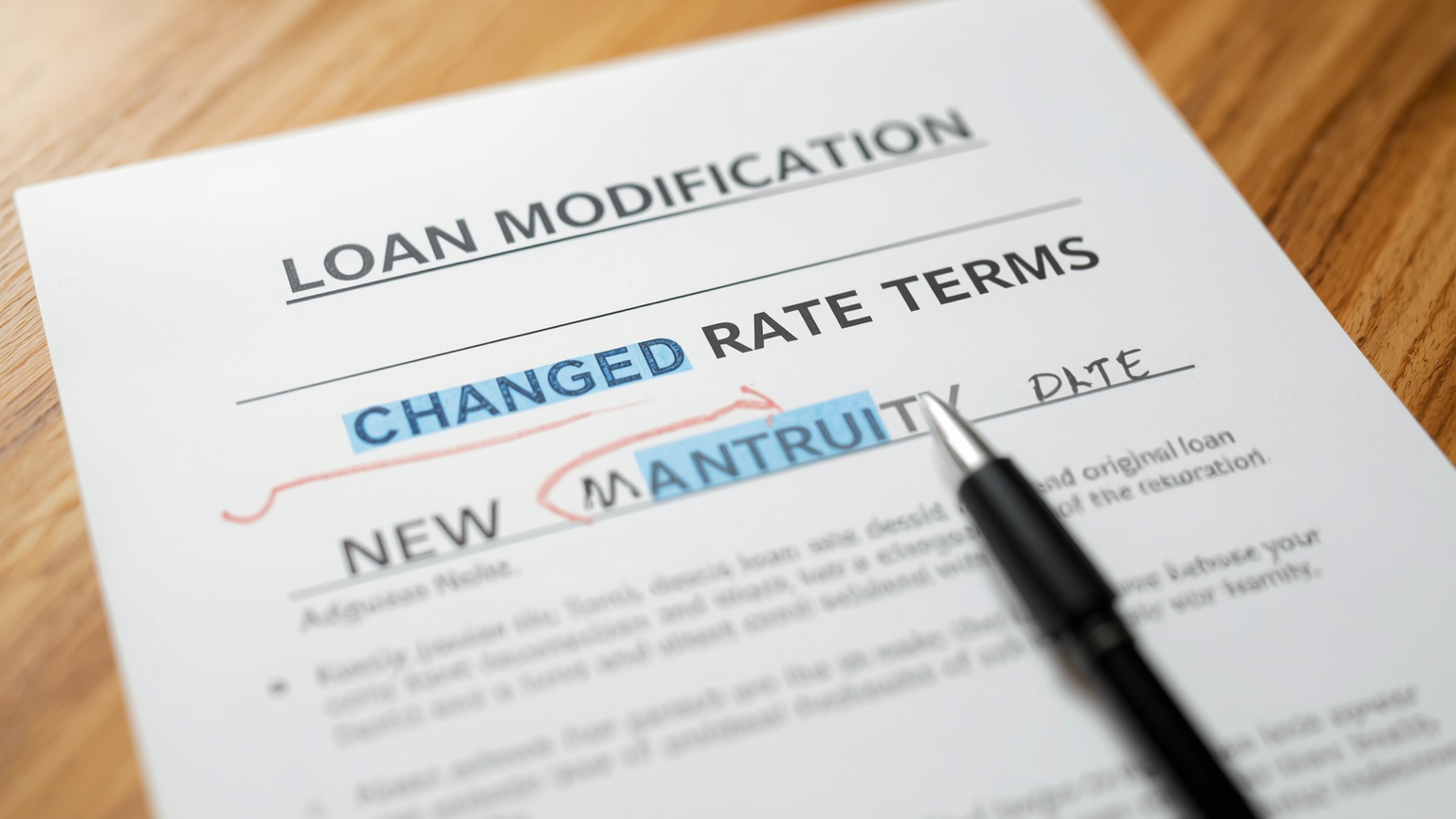

Mortgage loan modifications remain one of the most effective tools private lenders have for managing distressed loans without resorting to foreclosure. When a borrower can no longer meet the original terms of a mortgage, a modification allows the lender to restructure the obligation in a way that keeps the loan performing while protecting the lender’s investment in the underlying collateral.
For private lenders evaluating whether to offer a modification, understanding the mechanics, qualification standards, and long-term implications is essential to making informed decisions that serve both the lender’s portfolio and the borrower’s capacity to repay.
What Is a Mortgage Loan Modification?
A mortgage loan modification is a formal change to one or more terms of an existing mortgage agreement. It is fundamentally different from a refinance. In a refinance, the original mortgage is paid off and replaced with an entirely new loan, often from a different lender. A modification preserves the existing loan and adjusts its terms to reflect the borrower’s current financial circumstances.
The modification is documented through a written agreement between the lender and borrower that becomes part of the original loan file. Once executed, the modified terms govern the loan going forward, and the borrower’s performance is measured against these new terms rather than the original ones.
Common Modification Structures
Private lenders have considerable flexibility in how they structure modifications, and the specific terms should be tailored to the circumstances of each transaction. The most common modification structures include:
Interest Rate Adjustments
Reducing the interest rate lowers the borrower’s monthly payment obligation without changing the principal balance or loan term. This approach is most effective when the borrower has sufficient income to service the debt at a lower rate but cannot sustain payments at the original rate. For lenders, the trade-off is reduced yield in exchange for continued loan performance and avoidance of foreclosure costs.
Term Extensions
Extending the loan’s maturity date spreads the remaining principal balance over a longer repayment period, reducing the monthly payment amount. Term extensions are particularly useful for borrowers experiencing temporary cash flow disruptions who are expected to recover their earning capacity. Lenders should evaluate whether the extended timeline affects their portfolio duration targets and investor expectations.
Payment Structure Changes
Some modifications alter the payment structure itself, such as converting an adjustable-rate mortgage to a fixed-rate obligation, shifting from interest-only payments to an amortizing schedule, or establishing a graduated payment plan that increases over time as the borrower’s financial position stabilizes.
Principal Forbearance Within a Modification
In certain cases, a modification may include forbearance of a portion of the principal balance. The forborne amount is deferred to the end of the loan term and becomes due as a balloon payment at maturity or upon sale of the property. This reduces the borrower’s current payment obligation while preserving the lender’s right to collect the full principal balance.
When to Consider Offering a Modification
Private lenders should evaluate modification requests based on a combination of borrower circumstances and portfolio considerations.
Borrower-Side Factors
The strongest modification candidates are borrowers who have experienced a genuine financial hardship that affects their ability to meet the original loan terms but who retain sufficient income or assets to perform under modified conditions. Common triggering events include:
- Loss of employment or significant reduction in income
- Medical emergencies or disability that impairs earning capacity
- Death of a co-borrower or guarantor
- Business disruptions affecting commercial borrowers
- Property damage or casualty events that reduce rental income
The key distinction is between borrowers facing a recoverable hardship and those whose financial position has deteriorated beyond the point where any reasonable modification would result in sustained performance. Offering a modification to a borrower who cannot perform even under reduced terms simply delays the inevitable foreclosure while allowing the property to deteriorate.
Lender-Side Factors
From the lender’s perspective, the modification decision should account for:
- Foreclosure costs and timeline. In judicial foreclosure states, the process can take 12 to 24 months and cost tens of thousands of dollars in legal fees. A modification that keeps the loan performing may produce a better net outcome.
- Property value and equity position. If the property value supports the loan balance with adequate margin, the lender’s collateral position is secure, and a modification that preserves loan performance protects that position.
- Portfolio and investor obligations. Lenders managing pooled funds must consider how modifications affect reported yields, fund distributions, and investor communications.
- Regulatory considerations. Depending on the lender’s licensing and the nature of the loan, state and federal regulations may impose specific requirements on the modification process.
The Modification Process
Initial Borrower Contact
Borrowers who communicate early about financial difficulties are generally better modification candidates than those who go silent and allow defaults to accumulate. Lenders should encourage early communication and make modification inquiries straightforward.
Hardship Documentation
Most lenders require the borrower to document the hardship justifying the modification. This may include financial statements, tax returns, bank statements, medical documentation, or employer correspondence. The level of documentation should be proportionate to the modification requested and the loan amount.
Underwriting the Modified Terms
The lender should underwrite the modification as rigorously as it would underwrite a new loan. The borrower’s ability to perform under the modified terms must be verified, not assumed. If the borrower cannot demonstrate capacity to meet the revised payment schedule, the modification will likely fail, and the lender will have lost valuable time.
Execution and Recording
The modification agreement must be properly executed by all parties to the original loan, including any guarantors whose obligations are affected. If the modification extends the maturity date or increases the principal balance, recording the modification with the county recorder may be necessary to preserve lien priority, depending on the jurisdiction.
Credit Reporting and Borrower Impact
Private lenders should be transparent with borrowers about the credit implications of a modification. A modification typically results in a notation on the borrower’s credit report indicating that the loan terms were altered, which can affect the borrower’s ability to obtain future financing.
However, lenders should communicate that the credit impact of a modification is substantially less severe than the impact of a foreclosure. A foreclosure remains on a borrower’s credit report for seven years and can reduce credit scores by 100 to 160 points. A modification, while not without consequence, preserves the borrower’s credit standing to a far greater degree.
Temporary vs. Permanent Modifications
Temporary Modifications
A temporary modification adjusts loan terms for a defined period, after which the borrower must resume payments under the original terms and repay any deferred amounts. These are appropriate when the borrower’s hardship is expected to resolve within a predictable timeframe.
Lenders should structure temporary modifications with clear end dates and explicit terms governing the transition back to original payment requirements. Ambiguity about when and how the original terms resume creates disputes and may complicate enforcement.
Permanent Modifications
A permanent modification changes the loan terms for the remaining life of the loan. Once a permanent modification is executed, the original terms are superseded and the borrower’s obligations going forward are governed exclusively by the modified terms.
Some lenders require a trial period of six to twelve months of timely payments under temporary modified terms before converting to a permanent modification. This approach allows the lender to verify the borrower’s ability to sustain performance before committing to permanent term changes.
Preserving Lien Priority
One area that demands particular attention in private lending modifications is lien priority. Certain modifications, particularly those that increase the principal balance or extend the maturity date, may affect the lender’s priority position relative to intervening liens. State law varies significantly on this issue, and lenders should obtain title endorsements or legal opinions confirming that their lien priority is preserved following a modification.
Failing to address lien priority can result in a senior lien being subordinated to a junior lien that was recorded between the original mortgage and the modification, potentially devastating the lender’s recovery position in a subsequent foreclosure.
Conclusion
Mortgage loan modifications are a practical and often financially superior alternative to foreclosure for private lenders managing distressed loans. The key to a successful modification is disciplined underwriting of the modified terms, thorough documentation, and attention to legal requirements including lien priority and regulatory compliance.
For assistance structuring mortgage loan modifications, evaluating borrower hardship claims, or navigating lien priority issues, contact Geraci LLP at (949) 403-3488 or visit our offices at 90 Discovery, Irvine, CA 92618.